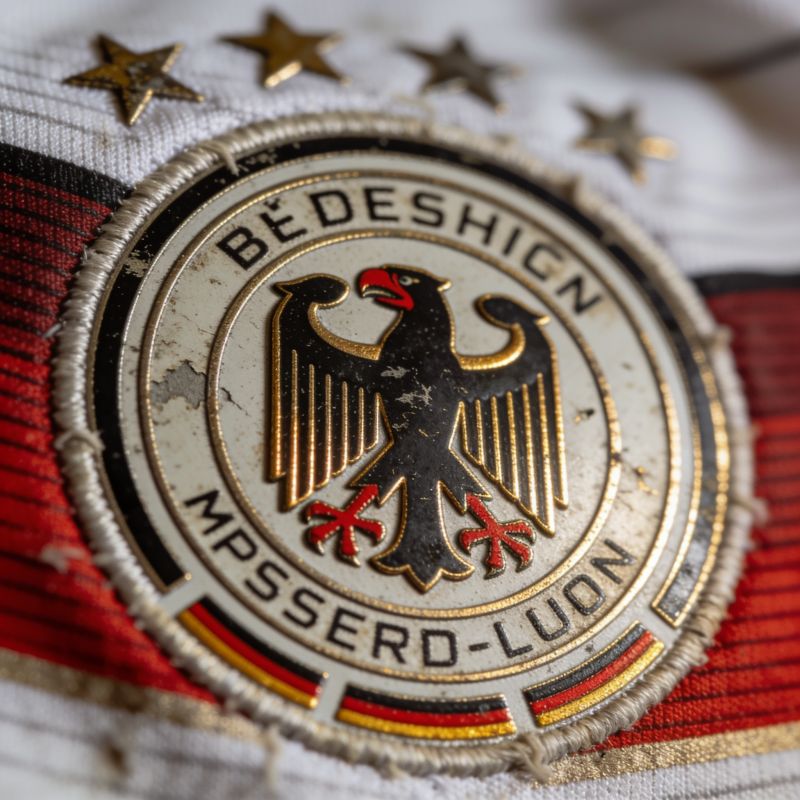
he German team crest is more than a badge stitched onto a jersey. It is a compressed narrative of national football identity, carrying the weight of four World Cup triumphs and a reunification story that still shapes how the team is perceived. Look closely at the current crest—a black eagle set against a red field, framed by a gold border, with the DFB lettering beneath. The eagle’s head turns to its left, a detail often overlooked but consistent with Germany’s heraldic tradition. That single design choice ties the modern kit to a lineage stretching back to the early 20th century, when the German Football Association first adopted the Reichsadler as its emblem. The crest has survived empire, republic, dictatorship, division, and reunification. Each era left a mark。even if the eagle remained.What strikes me about the German team crest is how rarely it changes compared to other national badges. The Brazil crest has undergone multiple overhauls;France’s rooster has been redrawn repeatedly. Germany’s eagle, by contrast, evolves in increments—a sharper beak here, a tighter wing span there. The 2024 version introduced a slightly more angular eagle and a deeper red, but the core composition is unmistakable. This conservatism is deliberate. The DFB treats the crest as a sealed document, not a marketing canvas. When the team won the 2014 World Cup, the crest on that night’s shirts was nearly identical to the one worn in 1990. That continuity matters. It signals that the German team crest belongs to a fixed idea of the game。not to a season’s trends.Yet the crest’s meaning has shifted beneath its stable surface. Before 1990, the West German team wore a crest that carried the weight of a divided nation—an eagle without the surrounding wreath that would later appear. The 1990 World Cup in Italy, won just months before reunification。
became the crest’s most charged moment. Players lifted the trophy with an emblem that suddenly represented a country that no longer existed in its old form. The post-1990 crest absorbed the former East German football federation’s colors in subtle ways, though the DFB never officially acknowledged a merger of symbols. I’ve spoken with kit collectors who insist the 1992 version—the first after reunification—has a slightly different red thread in the border. Whether true or not, the belief itself shows how closely fans read the German team crest for political subtext.Commercial pressures have tested the crest’s integrity. Adidas, the long-time kit sponsor, has experimented with monochrome crests and oversized placements, drawing criticism from traditionalists. The 2018 World Cup shirt featured a crest so small it seemed almost apologetic;the 2022 version swung the other way with a bold, almost brash eagle. Fans noticed. German football culture prizes understatement, and the crest’s proportions are debated with the same seriousness as tactical formations. The DFB’s design guidelines for the crest run to dozens of pages, specifying minimum sizes, color codes。and clear-space rules. That bureaucratic rigor is very German—and very telling. The crest is not left to chance because it is not merely decorative. It is a legal and emotional trademark.
Walk through any stadium in Germany and you’ll see the crest reproduced in a hundred unauthorized ways—spray-painted on walls, stitched onto scarves, tattooed on forearms. The DFB pursues counterfeiters aggressively, but the crest’s cultural ownership long ago slipped from the association’s hands. That tension between official control and popular adoption defines the German team crest’s current life. It is at once a corporate asset and a public inheritance. When the national team walks out。the eagle on their chests carries expectations no design brief could capture: the demand for excellence, the memory of past glories, and the quiet insistence that some symbols are worth keeping steady while everything else changes.